
Skip to content
  • Finnish Government
    • Prime Minister's Office
    • Ministry of Defence
    • Ministry of Transport and Communications
    • Ministry for Foreign Affairs
    • Ministry of Finance
    • Ministry of Economic Affairs and Employment
    • Ministry of Justice
    • Ministry of Education and Culture
    • Ministry of Social Affairs and Health
    • Ministry of the Interior
    • Ministry of Agriculture and Forestry
    • Ministry of the Environment

Valitse kieli:

This page is in Finnish. Go to the English site »

Or choose language:

Den här sidan är på finska. Gå till den svenska versionen av sidan »

Eller välj språk:

Dát siidu lea suomagillii Sirdás davvisámegielat siidduide »

Dehe vállje giela:

Taat sijđo lii suomâkielân Sirduu anarâškielâlijd sijđoid »

Tâi valjii kielâ:

Tät seidd lij lääʹddǩiõʹlle Sirddu lääʹddǩiõllsaž seiddõʹsse »

Leʹbe vaʹlljed ǩiõl:

Язык этого сайта финский. Перейти на русскоязычный сайт »

Или выберите язык:

Cette page est en finnois. Aller sur le site en français »

Ou choisir la langue:

Diese Seite ist auf Finnisch. Wechseln Sie zur deutschen Version »

Oder wählen Sie Ihre Sprache:

Tämä sivu on englanniksi. Siirry suomenkieliseen sivustoon »

Tai valitse kieli:

Choose language:

Den här sidan är på engelska. Gå till den svenska versionen av sidan »

Eller välj språk:

Dát siidu lea eŋgelasgillii Sirdás davvisámegielat siidduide »

Dehe vállje giela:

Taat sijđo lii eŋgâlâskielân Sirduu anarâškielâlijd sijđoid »

Tâi valjii kielâ:

Tät seidd lij eŋgglõsǩiõʹlle Sirddu lääʹddǩiõllsaž seiddõʹsse »

Leʹbe vaʹlljed ǩiõl:

Язык этого сайта английский. Перейти на русскоязычный сайт »

Или выберите язык:

Cette page est en anglais. Aller sur le site en français »

Ou choisir la langue:

Diese Seite ist auf Englisch. Wechseln Sie zur deutschen Version »

Oder wählen Sie Ihre Sprache:

Tämä sivu on ruotsiksi. Siirry suomenkieliseen sivustoon »

Tai valitse kieli:

This page is in Swedish. Go to the English site »

Or choose language:

Välj språk:

Dát siidu lea ruoŧagillii Sirdás davvisámegielat siidduide »

Dehe vállje giela:

Taat sijđo lii ruotâkielân Sirduu anarâškielâlijd sijđoid »

Tâi valjii kielâ:

Tät seidd lij ruõccǩiõʹlle Sirddu lääʹddǩiõllsaž seiddõʹsse »

Leʹbe vaʹlljed ǩiõl:

Язык этого сайта шведский. Перейти на русскоязычный сайт »

Или выберите язык:

Cette page est en suédois. Aller sur le site en français »

Ou choisir la langue:

Diese Seite ist auf Schwedisch. Wechseln Sie zur deutschen Version »

Oder wählen Sie Ihre Sprache:

Tämä sivu on pohjois-saameksi. Siirry suomenkieliseen sivustoon »

Tai valitse kieli:

This page is in North Saami. Go to the English site »

Or choose language:

Den här sidan är på nordsamiska. Gå till den svenska versionen av sidan »

Eller välj språk:

Vállje giela:

Taat sijđo lii tavesämikielân Sirduu anarâškielâlijd sijđoid »

Tâi valjii kielâ:

Tät seidd lij tâʹvvsääʹmǩiõʹlle Sirddu lääʹddǩiõllsaž seiddõʹsse »

Leʹbe vaʹlljed ǩiõl:

Язык этого сайта северосаамский. Перейти на русскоязычный сайт »

Или выберите язык:

Cette page est en same du Nord. Aller sur le site en français »

Ou choisir la langue:

Diese Seite ist auf Nordsamisch. Wechseln Sie zur deutschen Version »

Oder wählen Sie Ihre Sprache:

Tämä sivu on inarinsaameksi. Siirry suomenkieliseen sivustoon »

Tai valitse kieli:

This page is in Inari Sámi. Go to the English site »

Or choose language:

Den här sidan är på enaresamiska. Gå till den svenska versionen av sidan »

Eller välj språk:

Dát siidu lea anárašgillii Sirdás davvisámegielat siidduide »

Dehe vállje giela:

Valjii kielâ:

Tät seidd lij aanarsääʹmǩiõʹlle Sirddu lääʹddǩiõllsaž seiddõʹsse »

Leʹbe vaʹlljed ǩiõl:

Язык этого сайта инари-саамский. Перейти на русскоязычный сайт »

Или выберите язык:

Cette page est en sami inari. Aller sur le site en français »

Ou choisir la langue:

Diese Seite ist auf Inari Sámi. Wechseln Sie zur deutschen Version »

Oder wählen Sie Ihre Sprache:

Tämä sivu on koltansaameksi. Siirry suomenkieliseen sivustoon »

Tai valitse kieli:

This page is in Skolt Sámi. Go to the English site »

Or choose language:

Den här sidan är på skoltsamiska. Gå till den svenska versionen av sidan »

Eller välj språk:

Dát siidu lea nuortalašgillii Sirdás davvisámegielat siidduide »

Dehe vállje giela:

Taat sijđo lii nuorttâlâškielân Sirduu anarâškielâlijd sijđoid »

Tâi valjii kielâ:

Vaʹlljed ǩiõl:

Язык этого сайта скольт-саамский. Перейти на русскоязычный сайт »

Или выберите язык:

Cette page est en sámi skolt. Aller sur le site en français »

Ou choisir la langue:

Diese Seite ist auf Skolt Sámi. Wechseln Sie zur deutschen Version »

Oder wählen Sie Ihre Sprache:

Tämä sivu on venäjäksi. Siirry suomenkieliseen sivustoon »

Tai valitse kieli:

This page is in Russian. Go to the English site »

Or choose language:

Den här sidan är på ryska. Gå till den svenska versionen av sidan »

Eller välj språk:

Dát siidu lea ruoššagillii Sirdás davvisámegielat siidduide »

Dehe vállje giela:

Taat sijđo lii ruošâkielân Sirduu anarâškielâlijd sijđoid »

Tâi valjii kielâ:

Tät seidd lij ruõššǩiõʹlle Sirddu lääʹddǩiõllsaž seiddõʹsse »

Leʹbe vaʹlljed ǩiõl:

выберите язык:

Cette page est en russe. Aller sur le site en français »

Ou choisir la langue:

Diese Seite ist auf Russisch. Wechseln Sie zur deutschen Version »

Oder wählen Sie Ihre Sprache:

Tämä sivu on ranskaksi. Siirry suomenkieliseen sivustoon »

Tai valitse kieli:

This page is in French. Go to the English site »

Or choose language:

Den här sidan är på franska. Gå till den svenska versionen av sidan »

Eller välj språk:

Dát siidu lea fránskkagillii Sirdás davvisámegielat siidduide »

Dehe vállje giela:

Taat sijđo lii ranskakielân Sirduu anarâškielâlijd sijđoid »

Tâi valjii kielâ:

Tät seidd lij fraansk-ǩiõʹlle Sirddu lääʹddǩiõllsaž seiddõʹsse »

Leʹbe vaʹlljed ǩiõl:

Язык этого сайта французский. Перейти на русскоязычный сайт »

Или выберите язык:

Choisir la langue:

Diese Seite ist auf Französisch. Wechseln Sie zur deutschen Version »

Oder wählen Sie Ihre Sprache:

Tämä sivu on saksaksi. Siirry suomenkieliseen sivustoon »

Tai valitse kieli:

This page is in German. Go to the English site »

Or choose language:

Den här sidan är på tyska. Gå till den svenska versionen av sidan »

Eller välj språk:

Dát siidu lea duiskkagillii Sirdás davvisámegielat siidduide »

Dehe vállje giela:

Taat sijđo lii saksakielân Sirduu anarâškielâlijd sijđoid »

Tâi valjii kielâ:

Tät seidd lij saksslaǩiõʹlle Sirddu lääʹddǩiõllsaž seiddõʹsse »

Leʹbe vaʹlljed ǩiõl:

Язык этого сайта немецкий. Перейти на русскоязычный сайт »

Или выберите язык:

Cette page est en allemand. Aller sur le site en français »

Ou choisir la langue:

Wählen Sie Ihre Sprache:

  • Valitse kieli Suomi
  • Välj språket Svenska
  • Select language English
  • Vállje giela Davvisámegiella
Media
Ministry of Social Affairs and Health
Navigation
  • Frontpage Frontpage
  • Areas of expertise
    • Promotion of welfare Health promotion, harm and crime prevention, environmentional health, inclusion
    • Health and social services Services, healthcare and social welfare system, wellbeing services counties, status of clients, personnel, pharmacotherapy
    • Income security Allowances and benefits, pensions
    • Insurance Insurance institutions, statutory insurance
    • Working life Occupational safety and health, wellbeing at work
    • Gender equality Gender equality policy, equal pay
    • EU and international cooperation EU, Nordic cooperation, WHO, UN, ILO
    • Preparedness Preparedness planning, Medical Helpline 116 117
  • Current issues
  • Columns
  • Projects and legislation
  • Publications
  • Ministry
  • Contact
  • Press releases
  • News
  • MSAH on social media
  • Sign up for news
  • Service by publication
suomiLue artikkeli suomeksi svenskaLäs artikeln på svenska English

Finnish model for leisure activities increases schoolchildren's participation rate and reaches vulnerable groups
Ministry of Education and Culture
Publication date 10.12.2024 12.30
Type:Press release

The Finnish model for leisure activities offers children and young people free extra-curricular activities as part of their school day. The clubs already reach around one in four students attending comprehensive schools in Finland. The model not only increases children's and young people's engagement in leisure activities, but also improves opportunities for those who have found it difficult to pursue activities, especially if they come from low-income or one-parent families. The first results of the pilot project were collected from eleven municipalities of different sizes in autumn 2024.

During the 2024–2025 school year, We Foundation and the Ministry of Education and Culture are examining how the extra-curricular provision based on the Finnish model reaches children and young people from different family backgrounds. The pilot will continue until the end of the school year, collecting data directly from the parents and guardians of the children attending the clubs. The coverage of free-of-charge activities has not been studied in Finland on this scale previously.

Promising first results

The first results of the pilot, collected in the 2024 autumn term, provide evidence that the model has made a difference especially in these areas:

  • 16% of the respondents had not taken part in other extra-curricular activities in the previous six months.
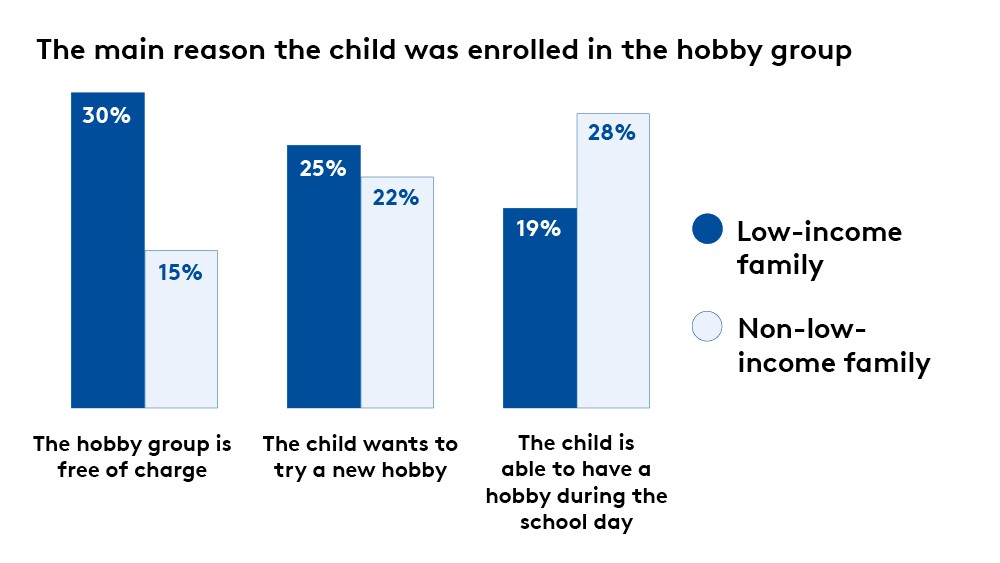
  • For low-income families, the key reason for participation was the fact that the activity was free of charge (29%), while non-low-income families found it important that the activity took place as part of school day (28%).
  • 25% of new participants from one-parent families had not engaged in extra-curricular activities before.

During the previous six months, 39 per cent of the respondents living in one-parent families had previously taken up a free extra-curricular activity organised as part of the school day. Only 37 per cent of those living in one-parent families had participated in an activity out of school hours. Of the children living with two parents, 55 per cent took part in activities out of school hours.

Socio-economic background affects take up of extra-curricular activities

There are clear differences in access to leisure activities by family background. In families with accumulated socio-economic disadvantage, only 30 per cent of children take part in extra-curricular activities out of school hours, while 42 per cent take part in activities as part of the school day and 28 per cent do not pursue any extra-curricular activities. In comparison, in families with no accumulated disadvantage, 59 per cent of children take part in activities out of school hours and only 10 per cent do not pursue any extra-curricular activities.

The extra-curricular provision based on the Finnish model brings together children and young people from different family backgrounds. Socio-economic risk factors, such as long-term unemployment, low income or parents' low level of education (at most comprehensive school education), affect children's access to extra-curricular activities. However, the clubs based on the Finnish model succeeded in bringing together children and young people from a variety of backgrounds:

  • 59% of the respondents came from families without socio-economic risk factors.
  • 29% had one socio-economic risk factor.
  • 12% had more than one socio-economic risk factor.

“It is clear that the Finnish model for leisure activities, which has been developed over several government terms, really works,” says Minister of Youth, Sport and Physical Activity Sandra Bergqvist.

"The central idea of the model is to offer meaningful extra-curricular activities which children and young people themselves have asked for. At their best, the clubs can provide the participants with an opportunity to learn about a wealth of activities and a path to finding a long-term interest," says Minister Bergqvist.

“We must systematically monitor and study the achievement of the objectives we have set for the Finnish model. We aim to ensure that as many children and young people as possible can have an extra-curricular activity they love. We must further improve access to activities in sparsely populated areas and boost cooperation with local sports clubs, cultural organisations and private sector providers,” she says.

In the pilot's next phase, data will be collected directly from the participants and their parents and guardians on how the extra-curricular provision based on the Finnish model affects schoolchildren's overall wellbeing and inclusion. 

“For We Foundation, the Finnish model for leisure activities is an ambitious initiative that can combat the growing inequality among children and young people. Children's and young people's lives can take different paths early on. Equal access to extra-curricular activities is an important means of preventing children and young people from being marginalised."

“To ensure that the resources spent on the Finnish model will generate the desired outcomes and the model will become a major Finnish social innovation, we should continuously measure the model's impact. Based on these first results, we can already show that the model has great potential and it reaches many children and young people from different backgrounds,” says CEO Tiina-Maija Toivola from We Foundation.

The municipalities that took part in the pilot's first phase were Akaa, Hämeenlinna, Joensuu, Liminka, Lohja, Nurmijärvi, Oulu, Porvoo, Rovaniemi, Sastamala and Somero. The municipalities joining in the next phase of data collection are Jyväskylä, Järvenpää, Kauhajoki, Kronoby, Lahti, Naantali, Pori, Seinäjoki and Vantaa.

The Ministry of Education and Culture awards around EUR 14 million annually in discretionary government grants to municipalities for organising extra-curricular provision. The 258 municipalities receiving grants have 511,000 students attending comprehensive schools. The municipalities estimate that 143,000 students have taken up an organised activity provided by the Finnish model. When all participating children and young people are added up, the Finnish model for leisure activities becomes Finland's largest club.

Inquiries:
Tiina Kivisaari, Director, Division for Sport, Ministry of Education and Culture, tel. +358 295 330 178, [email protected]

Henni Axelin, Director, Division for Youth Work and Youth Policy, Ministry of Education and Culture, tel. +358 295 330 205, [email protected]

Iina Berden, Ministerial Adviser, Division for Art and Cultural Heritage, Ministry of Education and Culture, tel. +358 295 330 069, [email protected]

Tiina-Maija Toivola, CEO, We Foundation, tel. +358 50 571 0457, [email protected]

Culture Sports Youth
amateurs children culture hobbies inquiry physical training young people
Back to top

Popular content

Wellbeing services counties on the map

Wellbeing services counties

Legislation on health and social services

Client charges in healthcare and social welfare

Social assistance

Child welfare

Services and benefits for old people

Current issues

Current issues

Press releases

Sign up for news

MSAH on social media

Service by publication

Information about the Ministry

Ministers

Ministry

Contact

For the media

The Ministry as a workplace

E-invoice address


About the stm.fi website

About the site

Data protection

Sitemap

Accessibility statement

Feedback

Ministry of Social Affairs and Health, link to frontpage

Link to an external website Link to an external website Link to an external website Link to an external website Link to an external website Link to an external website

Meritullinkatu 8, 00170 Helsinki

PL 33, 00023 Government, Finland

Switchboard +358 295 16001

registry.stm(at)gov.fi 

Administrative sector of the Ministry of Social Affairs and Health
finnishgovernment.fi
stm.fi Ministry of Social Affairs and Health - All of us have a right and privilege for healthy and safe live.
fimea.fi The Finnish Medicines Agency Fimea
stuk.fi Radiation and Nuclear Safety Authority
thl.fi The National Institute for Health and Welfare
ttl.fi Finnish Institute of Occupational Health
tyosuojelu.fi Occupational Safety and Health Administration
valvira.fi National Supervisory Authority for Welfare and Health
Search page
  • Frontpage
  • Areas of expertise
    • Promotion of welfare
      • Legislation
      • Health promotion
        • Fighting infectious disease
          • Fighting infectious disease: Responsibilities of the authorities
          • COVID-19 disease in Finland
            • Press releases about Coronavirus
          • Avian influenza
      • Promoting participation
        • Key areas of participation and inclusion
        • Roma policy
          • Advisory Board on Romani Affairs
        • Immigrants' social security, welfare and health
        • Disability policy
      • Substance harm prevention
        • Alcohol policy
          • Alcohol Act
        • Drug policy
          • Narcotics control
        • Tobacco and nicotine policy
          • EU regulation and cooperation
          • Other authorities’ responsibilities
          • Actions to reduce the use
          • Interaction with the tobacco industry
        • Harm caused by gambling
          • Gambling Policy Programme
          • Assessment of risks associated with gambling
          • Parties responsible for gambling policy
          • Gambling system
      • Preventing violence and crime
        • Combating domestic and intimate partner violence
          • NAPE – Committee for Combating Violence against Women and Domestic Violence
        • Combating trafficking in human beings
        • Mediation in criminal and civil cases
        • Violence against children and its prevention
        • Responsibilities in preventing domestic and family violence
      • Environmental health
        • Radiation protection
        • Chemical oversight
          • Cosmetic products
          • Tattoos
        • Advisory Board on Biotechnology
      • Advisory Board for Public Health
    • Health and social services
      • Legislation
        • Children, young people and families
        • Older people
        • Secondary use of health and social data
          • Frequently asked questions about the Act on Secondary Use of Health and Social Data
          • Amending the Act on the Secondary Use of Health and Social Data
          • EHDS Regulation
      • Responsible agencies
        • Wellbeing services counties
          • Wellbeing services counties on the map
          • Guidance of the wellbeing services counties
          • Collaborative areas
        • Municipalities
        • Supervisory authorities
        • Private providers of health and social services
        • Centres of excellence on social welfare
        • Organisations and associations
      • Social services
        • Disability services
        • Child welfare
          • Frequently asked questions concerning child welfare in Finland
      • Health services
        • Primary health care
          • Screening
            • Prenatal screening
          • Vaccinations
            • HPV vaccinations
          • Maternity and child health clinics
          • School health care
          • Student health care
        • Occupational health care
        • Private health care
        • Mental health services
        • Services for substance abusers
        • Hospitals and specialised medical care
        • Urgent and emergency health services
        • Client and patient safety
        • Healthcare and social welfare for undocumented persons
        • Termination of pregnancy
      • Rehabilitation
      • Pharmacotherapy
        • Value chain for pharmacotherapy
        • Legislation, steering and supervision, cooperation
        • Safety of pharmacotherapy
        • Rational pharmacotherapy
          • Implementation of sensible pharmacotherapy
          • Information management
            • Digital services
      • Client and patient rights
        • Patient ombudspersons and social services ombudspersons
      • Client fees
      • Healthcare and social welfare personnel
        • Frequently asked questions about the operating models and division of duties of healthcare and social welfare personnel
      • Children, youth and families
        • Services to families
      • Older people services
        • Services and benefits
      • Social security and services for asylum seekers in Finland
        • Healthcare and social welfare for illegal residents
        • Health and social services for people arriving from Ukraine
      • Information management
    • Income security
      • Legislation
      • Financial assistance for families with children
      • Conscripts allowance
      • Housing allowance
      • Unemployment
      • Sickness and rehabilitation
      • Pensions
        • Earnings-related pension
        • National pension
        • Guarantee pension
        • Disability pension
        • Survivors’ pension
      • Front veterans
      • Social security for athletes, grant recipients and students
      • Social assistance
      • Social lending
      • Support and benefits
      • International social security
      • Appealing income security decisions
      • Occupational accidents and illnesses
    • Insurance
      • Legislation and oversight
      • Insurance institutions
      • Supervision of the insurance sector
      • Investing insurance contributions
      • Statutory insurance
      • Social insurance contribution
      • Insurance related appeals
    • Working life
      • Legislation
      • Posted workers
      • Generally applicable collective agreements
      • Occupational safety and health
      • Supervising OSH
        • European cooperation on market surveillance
        • Workplace harassment
        • Vera ICT System
      • Occupational health care and maintaining work ability
        • Value of lost labour input in Finland
      • Development of working life
      • Wellbeing at work
      • Equality in working life
      • Young people and work
      • Family life and work
      • Older workers
    • Gender equality
      • Legislation
      • Mainstreaming
      • Gender equality in working life
        • Equal pay
      • International cooperation
      • Responsible agencies
    • EU and international cooperation
    • Preparedness
      • Pandemic preparedness
  • Current issues
    • Press releases
    • News
    • MSAH on social media
    • Sign up for news
    • Service by publication
  • Columns
  • Projects and legislation
    • All projects and working groups
    • Sufficiency and availability of healthcare and social welfare personnel
    • Social security reform
      • General social security benefit
    • Defining the principles for service choices in healthcare and social welfare
    • National service reform
    • Mental health policy strategy
    • Child Strategy
    • RDI Growth Programme for Health and Wellbeing
    • Sustainable Growth Programme for Finland
    • Reform of pharmaceutical matters
    • Personalized medicine
      • Improving health through the use of genomic data
      • Overall project description
      • Genome Center
      • National Cancer Center
      • Biobank Operations
      • National neurocenter
      • Drug Development Centre
      • People and contact details
      • European ‘1+ Million Genomes’ Initiative
    • National health and wellbeing programme Terveydeksi
    • Working life programmes 2023-2027
      • Mental Health at Work Programme
    • National Cancer Strategy
  • Publications
  • Ministry
    • Management and organisation
      • Responsibilities of ministers in the Ministry of Social Affairs and Health
      • Minister of Social Affairs and Health
      • Minister of Social Security
      • Senior Civil Servants
      • Department for Steering of Healthcare and Social Welfare (OHO)
      • Department for Insurance and Social Security (SVO)
      • Department for Safety, Security and Health (TUTO)
      • Department for Communities and Functional Capacity (YTO)
        • YPA - personnel
      • Department for Clients and Services in Healthcare and Social Welfare (APO)
      • Department for Work and Gender Equality (TTO)
      • Strategic and Financial Management Unit (STAR)
      • Human Resources and Administration Unit (HEHA)
      • International Affairs Unit (KVY)
      • Communications Unit (VIE)
    • Strategy
    • Administrative branch
    • Preparedness
      • Pandemic preparedness
      • Preparedness centres
      • Preparedness in the EU
      • Radiation accidents
      • Preparedness in Wellbeing Services Counties
      • Preparedness in wellbeing services counties
    • International cooperation
      • European Union
        • Preparation of EU affairs
      • Council of Europe
        • European Committee of Social Rights
      • United Nations
      • World Health Organization
        • WHO pandemic treaty
      • Global health security
      • Nordic cooperation
        • Finland's Presidency of the Nordic Council of Ministers in 2021
      • Northern Dimension
      • Barents cooperation
      • Arctic cooperation
      • International Labour Organization
      • OECD
    • Finances and operations
    • Expenditure
    • The Ministry as a workplace
      • Working for the Ministry of Social Affairs and Health
      • Ministry personnel statistics
      • Principles of a safer space
      • Read more about jobs
    • Whistleblower protection
    • Statistics
      • Statistics on the promotion of welfare and health
      • Statistics on social welfare and health care services
      • Statistics on income
      • Statistics on insurance
      • Statistics on employment
      • Statistics on equality
  • Contact
    • Personnel search
    • E-invoice address
    • For media
    • Feedback
    • Data Protection
      • User's rights and requests for personal data
      • Information system descriptions
      • Publicity of documents and requests for information
      • Information on cookies on the website
    • Accessibility statement for the stm.fi website